


 case study

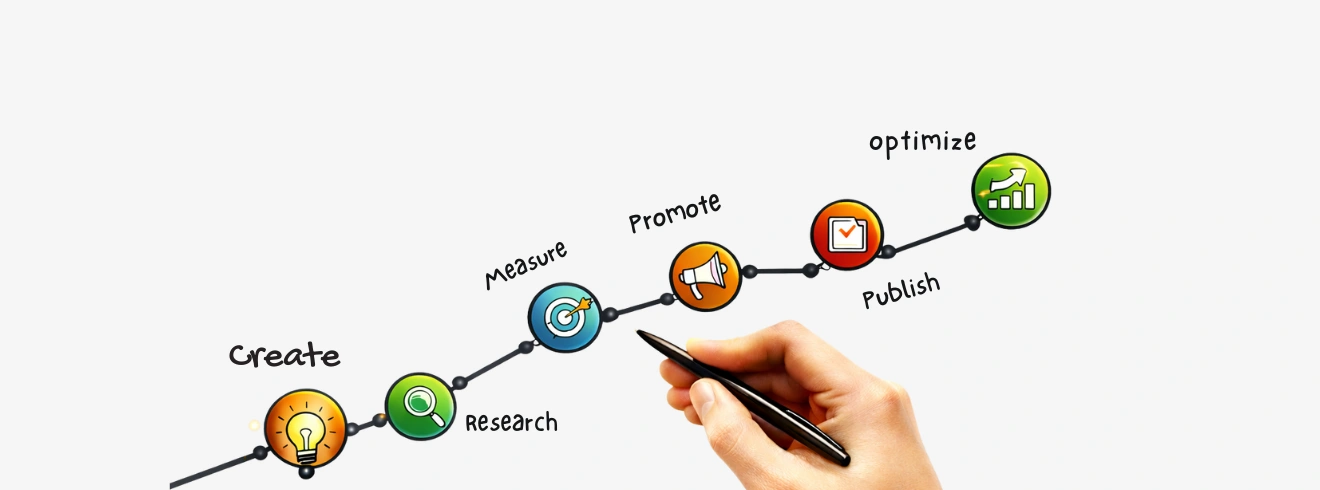
Strong content strategy transforms disorganized posts into a brand-identity system that earns trust, attracts attention, and collaborates for growth. It maintains your voice, cuts through the noise with your storytelling, and gives your marketing the power to measure success. Without strategy, content becomes noise and with strategy, it becomes brand equity that increases over time.
At Blacklisted, we see strong content strategy as the difference between brands that get noticed and brands that get remembered. It is not a post-scheduling calendar but rather a distinctive framework that clarifies for you what to say, the reason for saying it, and the proper place for it so that your message will be received with uniformity.
In this blog, we will deconstruct the concept, the role of brand voice, and the reason why content marketing is successful only when strategy comes first.
In simple terms, content strategy is a system for making decisions. It specifies the topics that are important, the platforms that are worth attention, and the brand’s definition of “good content.” A posting plan merely indicates when to publish. The strategy addresses why it exists and what it should attain.
When brands refrain from taking this step, they get into a reactive situation. They create content because, for instance, the competitors have posted something, a trend is hot, or the week seems too quiet. The result is very likely to be that the audience will soon forget them due to the inconsistent messaging, uneven quality, or being just another copycat.
A strong content plan does not stay in a file, rather comes out in the real world, striking through the channels where your audience is. It decides what you produce, how you distribute it, and how every single piece contributes to the main narrative.
This includes not only your long-form content marketing assets but also your day-to-day social media content marketing. And your performance-driven formats like video advertising, too. These are not separate topics—they are connected parts of the same system.
In the sections ahead, this blog will unpack how the strategy builds the foundation first, and then how storytelling, social media, and video fit into it and push results further.

People do not trust brands because of just one excellent post. They trust brands that show up the same way every time. The same tone. The same promise. The same level of clarity. That consistency is not accidental. It is a result of proper content planning.
Consistency also protects brand’s image. If a brand appears premium on its website but relaxed on social media, it will create a barrier to the consumers. If a brand instructs in one post and hard-sells in the next, it will cause scepticism. In this way, trust is gradually lost.
A strong strategy keeps blogs, landing pages, emails, social posts, and ads working together. It ensures that one customer gets to see one story rather than five disconnected versions of it. That alignment is where the brand’s confidence comes from.

Brand voice is the personality of your brand expressed in words. It’s the manner you communicate, the words you often use, and the overall disposition you project through the different channels. Some brands are very expressive and straightforward, while some are very soothing and friendly. But the important thing is that they all sound like themselves no matter the place they are at.
The creation of a content strategy can be viewed as a transformation of brand voice into a systematic process that can be exercised. It lays down the courts for tone, vocabulary, messaging limits, and even rhythm of sentences. In this way, no matter whether the content is produced by one writer or by ten, it will still sound like one brand.
In the absence of a strategy-led voice guide, the content will soon become confusing and varied. Social media will be trend-focused. Blogs will be keyword-focused. Ads will be offer-focused. Before you know it, the brand is perceived as a group of campaigns rather than having a united identity.
Storytelling is not about writing emotional lines for the sake of it. It is about structuring information in a way that people remember. Stories build context, tension, and payoff. They make content feel human.
In content, storytelling shows up in:
When storytelling is strategic, it does not feel like a one-off creative spike. It becomes a narrative thread. A strong content plan decides what the brand stands for, what it challenges, and what it consistently teaches. That is what turns storytelling into brand equity.
Creative content connotes the freshness, uniqueness, and the ability to engage emotions. However, creativity without a guide soon turns out to be chaos. The brand indulges in wrong formats, weakens trust through humour, and uses visuals that don’t belong to them.
A strategy makes a place for creative content. It conveys to the creators what the right experiments and what the wrong ones are. Moreover, it ensures that the team does not go through the process of inventing a new one every week.

Creativity is the output when the content is strategic. It aids brands to:
At this point, creativity is no longer merely an opinion. It becomes a repeatable advantage.
Social media Is not a random posting channel. Social media content marketing works when it is built like a system. Trends can support reach, but they cannot be the plan. A brand that only posts trends becomes forgettable because it never builds an identity.
A good strategy decides:
The strongest social brands are not those that post the most. They are the ones that sound familiar every time they appear. That familiarity comes from the strategy, not from luck.

Video advertising gets the job done since it conveys feelings, clarity, and a tale very quickly. It can provide evidence, show a change, and express a character in a manner that static content cannot. Nevertheless, video can only be of good use if it is in harmony with the funnel. Awareness videos must be able to hook very quickly. Consideration videos must be able to explain value very clearly. Conversion videos must make the next step, obviously, and reduce the friction.
Without a strategy, brands make videos that are very impressive visually but do not attract people. A strategy-led approach specifies what result the video should get, where it will be used, and how it connects with the post-click experience. That is how video turns into a performance tool instead of a budget drain.
The primary reason that most digital marketing services get it wrong is not that the right audience wasn’t targeted, but rather the content couldn’t attract or even trust. They fail because the content cannot hold attention or build trust. SEO needs useful pages. Effective hooks are needed for advertising. Clarity is mandatory for emails. Social media demands unity of approach.
A strong content plan gives every channel what it needs. It ensures that while the formats change, messaging remains aligned.
When content is consistent, ad fatigue drops. When landing pages match ad promises, conversions rise. When blogs answer real questions, their rankings improve. Strategy does not create results by chance. It creates the conditions where results become easier to attain.
This is the kind of work we do at Blacklisted. First, we create the base, then let the performance and creativity grow on top of it.
A brand becomes successful when it earns trust at scale, and that only happens with a strong content strategy.
Strategy turns content into a system that keeps brand voice consistent, storytelling memorable, and marketing measurable. It also makes creative content repeatable instead of random, and it helps video advertising and social media content marketing work as part of one connected experience.
Most importantly, it gives digital marketing services the clarity they need to perform without relying on guesswork. Brands that treat content as strategy win attention, loyalty, and growth. That advantage compounds with time.

We are your go-to source for everything digital. We cover marketing tips, design trends, new tech, and how to build your brand. Every post has useful information to keep you updated and ready to tackle the digital world. It’s not just articles; it’s a way to learn, grow, and connect with others navigating the same digital journey.






Social Media Content Marketing Needs More Than Trends