case study


Brand identity design isn’t just about the aesthetics of a brand; rather, it is about the whole brand feeling to be credible, recognised, and trusted wherever it shows up. Strong design creates consistency across touchpoints, improves perceived value, and helps people remember and choose a brand with confidence.
Many brands spend tremendous amounts of money on marketing, but still find it difficult to be credible or remembered. Usually, the problem is not with the product or the message but with the weak or inconsistent brand identity design.
In this blog, we explain why good design forms the foundation of strong brands, what kind of benefits it provides, and how to approach brand identity in a way that earns lasting trust.
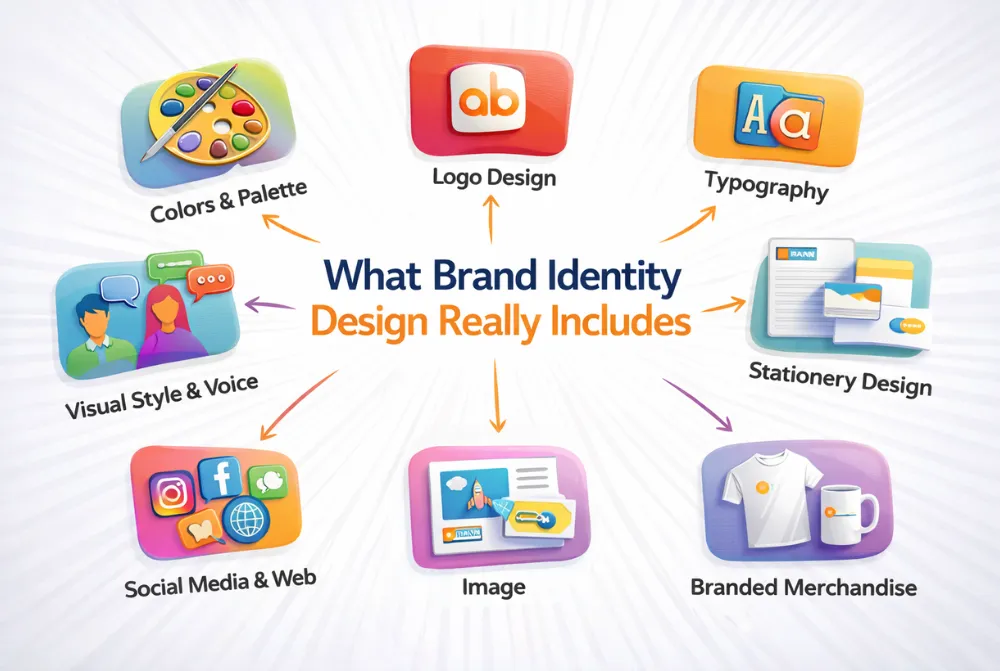
Widely, the extent of brand identity is limited to “the logo,” but this is where many companies make a mistake. While a logo is indeed significant, it merely serves as the entrance to the brand. The true brand design is the entire visual system that is people’s repetitive experience across the different platforms, formats, and moments from the very first website visit, a social post, a proposal deck, to even product packaging.
We prefer to consider identity as a toolbox. It provides consistent components that allow every piece of communication to look like it came from the same source, even if created by different teams. That is the reason why company logo design should never be seen as the whole project. A logo is just one part of a larger system that has to be coherent and functional.
A classic brand design system generally has the following components:
When all these elements function in harmony, it gives the impression that your brand has been around for a while and is, therefore, trustworthy. This familiarity is not a “nice-to-have.” It is among the quickest ways to get trust.
Branding is the discipline of ensuring that your brand looks intentional everywhere, not just in one perfect mock-up. Customers do not experience you in a single place. They move between Google results and social platforms, landing pages and email, often within minutes. If those touchpoints appear disconnected, people assume the business is less established or less reliable, even if the offering is strong.
On the flip side, consistency makes the execution easier. The teams have a clear system, they stop reinventing design decisions each time. Instead of debating colours and fonts on every new asset, you build faster, with fewer mistakes, while the brand remains visually stable.
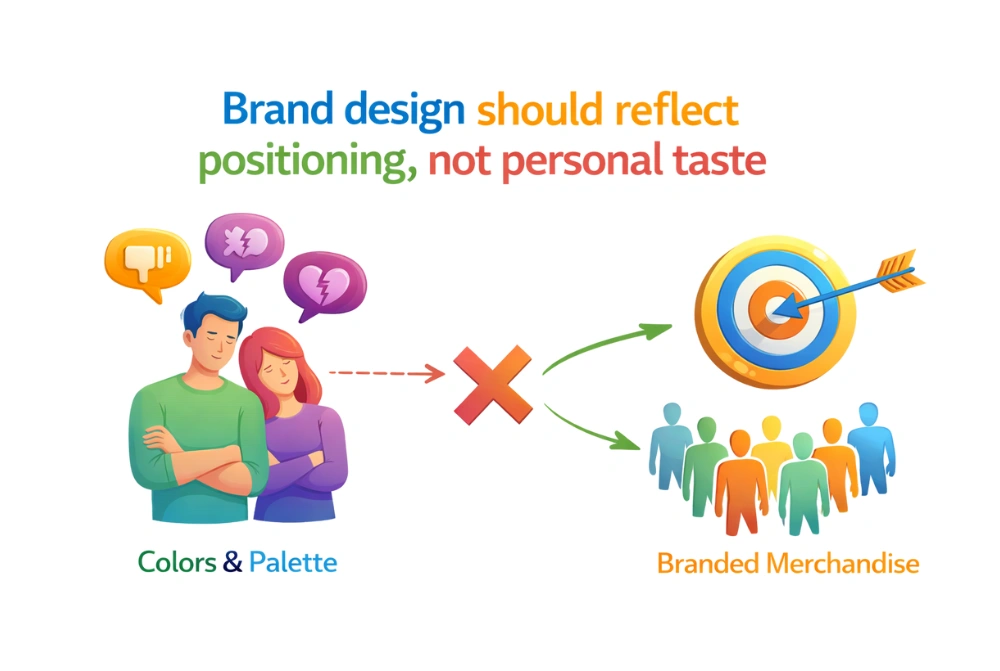
It is the one that expresses your brand’s positioning clearly. A brand, for instance, that wants to be seen as luxurious should not have the look of a budget marketplace. A brand that wants to attract a wide audience should not appear to be cold or too corporate. When positioning and design coincide, consumers have an easier time understanding your brand and therefore offering their trust more readily and quickly.
This is where the creative strategy becomes a necessity. The strategy gives the direction, and the design visually transforms that direction into something that is recognisable, memorable, and credible for the audience.
Many brands make a huge investment in visuals, but then do not create guidelines or consider them as an afterthought. Usually, this results in slow dilution. Over a period of time, the colours drift, fonts get changed, logos are stretched, and the number of templates increases. Brand design remains strong only as long as the guidelines are there to make it easy for the different departments and partners to apply the identity correctly.
Good guidelines are practical. They do not simply consist of rules; rather, they help to eliminate confusion and to accelerate the work process. If the rules are simple to follow, it will be easier to safeguard the brand.
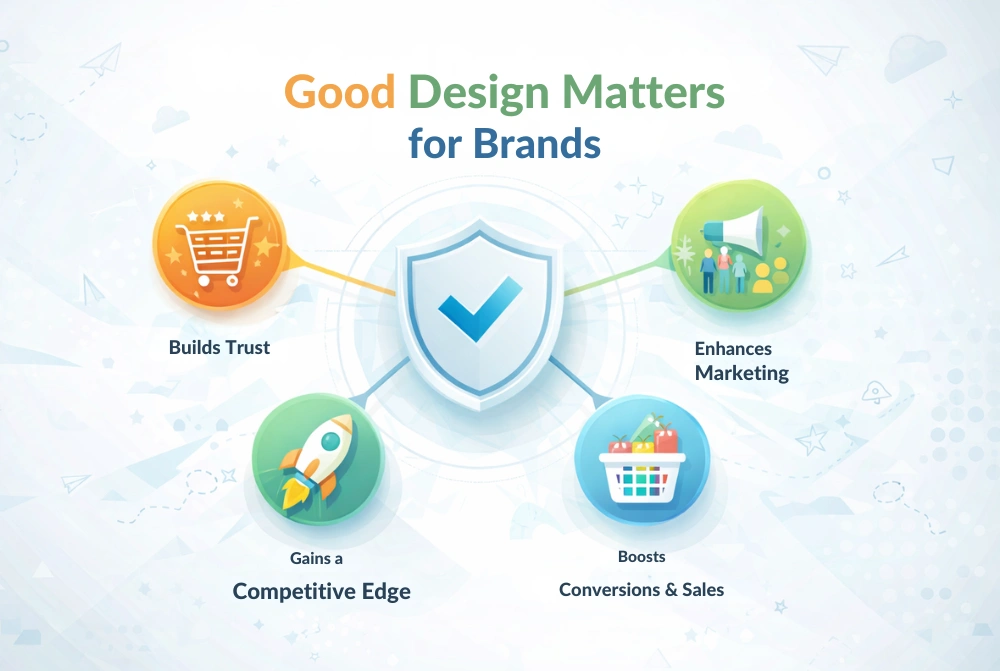
Good design is extremely important because people take quick decisions, and most of these decisions are emotional ones rather than rational. Even in B2B, buyers do respond to signals.
A brand that has a sharp and consistent design and is also thoughtful in its branding looks more credible than one that is just stitched together.
People get an impression even before reading a whole paragraph. The first things noticed are layout, space, typography, and images. If the design comes across as chaotic, old-fashioned, or unremarkable, the trust factor will go down early. On the other hand, if the design is clear and intentional, the audience will be more ready to explore, read, and engage with it.
This, however, is not superficial. Design turns into a quick way to pass judgement, and brand identity design takes charge of that quick way.
Your brand identity influences what people believe you are worth. A consistent identity can raise the perception of a brand up to the level of premium, establishing it as more reliable and trustworthy. This is where the custom logo design usually comes into play since it does not solely create value but becomes a part of the entire system that signals quality and intent which is much broader.
Confusion makes people postpone their decisions. When customers are not able to make a decision, they probably go away. Great design minimizes this friction by communicating the message clearly via visuals so that it is easily understood.
Visual hierarchy directs the viewer’s attention. Layout directs a reader’s eyes to the most important parts. Typeface has a great impact on legibility.
Brand Design is an integral part of the overall design; it creates repeated patterns that users learn easily. After a time, users get comfortable and their confidence to choose you grows.
The vast majority of industries have very similar online faces. Same-same websites, same templates, plus minus identical visual cues. In such a case, the brand becomes the only way to identify the company. A constant and unique brand design makes you easier to recognise, even when you are not actively trying to remember.
Being distinguishable is not always a matter of being loud. More often it is simply being clear, consistent, and unmistakably your own.
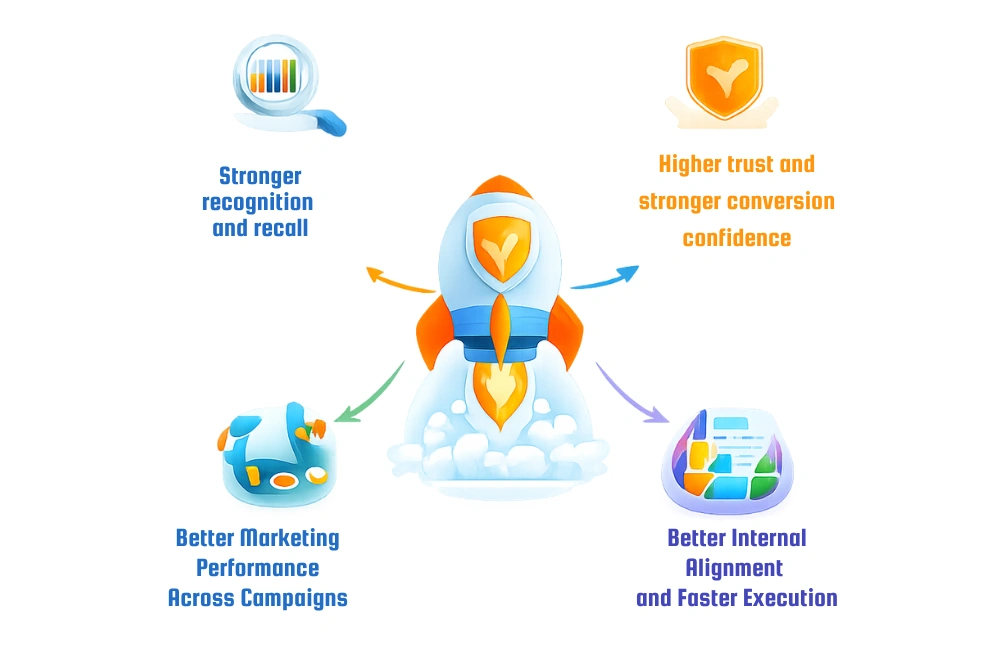
Creating a good design is not an expenditure for show. It provides a series of practical benefits that become more significant the longer they are in place, particularly when your brand gets larger:
Recognition is acquired through constant exposure. The moment your visual system remains unvaried across various channels, people will start to identify you in no time. Recognition is a way to lessen the demand on the consumer’s part. A brand that is easy to recognise feels familiar, and familiar brands are chosen more often.
Trust does not relate solely to what people say, good or bad, about the brand. The brand might also have the characteristics of signals. A consistent-looking brand is perceived as more trustworthy. That feeling or perception plays a part in whether a person will go ahead and fill out a form, ask for a quote, book a call, or even reply to an email.
Customers might not put it in words, but design is a major factor in whether you feel “safe to choose” or not.
A strong identity pushes marketing efforts to work harder. Ads are elevated to a more professional level. Social content becomes cohesive. Landing pages feel aligned with the brand promise. The email designs appear to be well-thought-out. The campaigns do not feel like separate trials any more but instead are perceived as one big clear narrative.
Brand identity is not solely an external factor. It helps internal teams communicate with consistency and pride. With clear guidelines and templates, teams move faster and spend less time debating visual decisions. That saves time, reduces errors, and protects the brand from slow dilution.
At Blacklisted, we create identity with clarity first, then creativity. This means we do not begin with visuals, but rather with the essential characteristics of the brand that it should be known for and the emotions that the audience should experience.
We set the basics before the sketches or mood boards such as who the audience is, how the brand is different, and what it should be associated with in the market. Once those questions are answered, design decisions are made easier, sharper, and more consistent.
Brand identity design is not a mere decoration. It is an infrastructure. It determines the way trust is established, the speed of recognition, and the effectiveness of marketing over time. The branding design, when approached as a system guided by creative strategy and supported by usable guidelines, becomes an asset that compounds year after year.
At Blacklisted, the objective is always the same: to assist your brand in getting a uniform appearance, being impressive at the same time, and finally, being unmistakably recognised no matter how and where people come across it.

We are your go-to source for everything digital. We cover marketing tips, design trends, new tech, and how to build your brand. Every post has useful information to keep you updated and ready to tackle the digital world. It’s not just articles; it’s a way to learn, grow, and connect with others navigating the same digital journey.