case study


An effective E-commerce SEO strategy helps online stores increase visibility, attract high-intent users, and drive conversions. From keyword research to technical optimisation and content, mastering e-commerce SEO is essential for scalable growth and long-term success.
If your online store isn’t showing up in search results, it isn’t selling. That’s the truth. A good E-commerce SEO strategy is now a must. It’s what sets apart stores that sell regularly from those that nobody sees. With more competition, just using ads isn’t enough. People who find your store through search engines are where long-term growth comes from.
As an established SEO agency in India, we’ve seen many brands spend a lot on products and design but forget about the one thing that helps people find them: search engines.
Let’s break down what actually works.
At the heart of it, e-commerce SEO is about making your online store show up higher in search engine results so you can attract buyers without paying for ads.
Unlike SEO, e-commerce SEO is all about:
A good e-commerce SEO plan makes sure your products pop up when people are searching for them.
This means:
As the best digital marketing agency in Mohali, we don’t just tick boxes with SEO. But we treat it as a revenue system and help your business with the same.
To be honest, your store needs paid traffic if you don’t use e-commerce SEO. That costs a lot and is not too stable.
Here’s why it matters:
As an SEO agency in India, we focus on making growth channels that last, not just quick boosts.
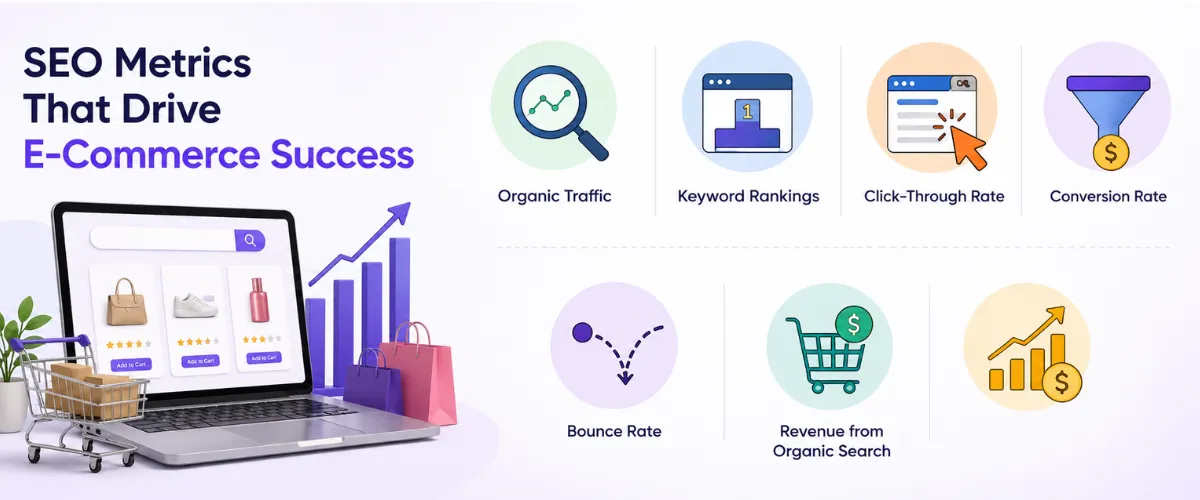
When you are looking at how your SEO is doing it is not just about seeing if more people are visiting your website. For a store that sells things online the important thing is to know if all these visitors are actually helping your business make money. A good plan for SEO on an E-commerce website should look at the numbers that show how being visible online is connected to sales.
| SEO Metric | Why It Matters for Ecommerce SEO |
|---|---|
| Organic Traffic | Measures how many visitors find your store through search engines. |
| Keyword Rankings | Tracks your visibility for product, category, and buyer-intent keywords. |
| Click Through Rate (CTR) | Shows how effectively your titles and meta descriptions attract clicks. |
| Conversion Rate | Measures how many visitors become customers or complete desired actions. |
| Bounce Rate | Indicates whether users find your content relevant and engaging. |
| Revenue from Organic Search | Reveals the actual business impact of your SEO efforts. |
| Average Session Duration | Shows how long visitors engage with your website and content. |
| Pages per Session | Measures how effectively users navigate through your store. |
| Indexed Pages | Ensures important product and category pages appear in search results. |
| Backlink Growth | Indicates increasing authority and trust in search engines. |
Monitoring these metrics helps businesses understand whether their Ecommerce SEO strategy is driving meaningful results. While rankings and traffic are important, the ultimate goal is to increase qualified visitors, improve conversions, and generate more revenue from organic search. This data helps identify opportunities for optimization and long-term growth.
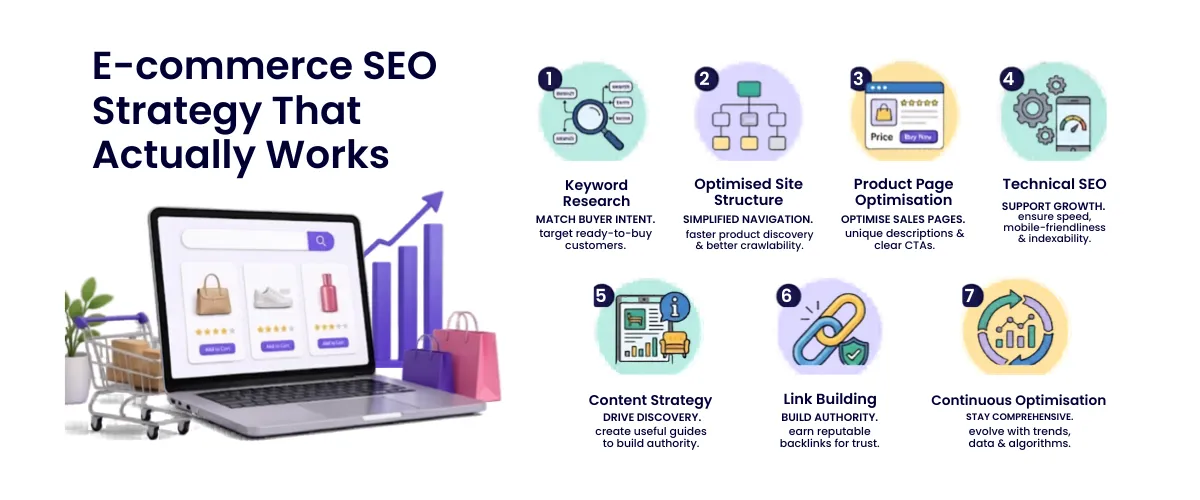
Many online stores do the thing wrong. They put up product pages, add keywords and wait for people to come to their site. This is not the way to do it. A good e-commerce SEO strategy needs to be planned, consistently updated and understanding of how customers search for things before they make a purchase.
Doing keyword research is the fundamental step in making an e-commerce SEO plan. It should not just be about using popular keywords. Businesses need to know the difference between people who are just looking around and people who are ready to buy something.
For example, someone looking for “running shoes for flat feet” might still be looking at different options. Someone searching for “buy running shoes for flat feet online” is more likely to actually make a purchase. Your E-commerce SEO strategy should include both types of searches. The pages for products and categories should focus more on people who want to buy something. E-commerce SEO is about understanding what buyers want and giving it to them.
This usually includes:
The better your keyword mapping, the easier it becomes to attract users at different stages of the buying journey.
A well-structured ecommerce website helps users find products quickly and allows search engines to crawl pages efficiently. Clear categories, subcategories, and internal links improve navigation, rankings, and overall user experience.
Benefits of a Good Site Structure
This is more concise, easier to read, and better for AI extraction.
| Optimization Area | SEO Benefit |
|---|---|
| Unique Category Content | Improves rankings |
| Optimized Meta Tags | Increases CTR |
| Internal Linking | Improves crawlability |
| Category FAQs | Supports AI and voice search |
| Schema Markup | Enhances search visibility |
Category pages are often some of the most valuable pages on an ecommerce website. They target broader search terms, help users discover products, and distribute authority across the site. Optimizing category pages with unique content, internal links, FAQs, and structured data can improve rankings and user experience.
Product pages must be seen as sales pages. They should do more than just list out what the product is. They must address concerns, feature benefits, have keywords, and drive conversion.
A poorly constructed product page will contain generic descriptions, lack information, poor images, and no clear call to action. That makes it harder to rank well or convert from traffic.
A strong product page will have the following:
| Product Page Element | Why It Matters |
|---|---|
| Unique Product Titles | Improves search visibility |
| Optimized Meta Tags | Increases click through rate |
| Product FAQs | Supports voice and AI search |
| Customer Reviews | Builds trust and conversions |
| High Quality Images | Improves user experience |
| Schema Markup | Helps search engines understand products |
A well-optimized product page does more than improve rankings. It helps search engines understand product information, improves user experience, and increases the likelihood of conversions. Including FAQs, reviews, structured data, and clear product details can improve visibility across traditional search results and AI-powered search experiences.
Technical SEO is usually unseen, yet it impacts everything. A store may offer quality products and content, yet if the site is not quick, crawlable, or mobile-friendly, its ranking could be negatively affected.
With e-commerce, technical SEO becomes even more critical since there are hundreds or even thousands of web pages. Filters, duplicate URLs, out-of-stock pages, and poor indexing can present SEO challenges for the online store.
Important technical areas include:
Everyone does not always conduct a direct search for a specific product. They conduct searches based on queries, comparisons, guide pages, or even problem-solving searches. This is where the power of content becomes a useful strategy for e-commerce brands to attract customers.
A furniture company could rank for “choosing a dining table for a small area” without the customer being ready to buy yet. A skincare company could develop guides related to ingredients, products, and even product comparison guides.
Useful content helps your store:
This is how e-commerce SEO expands beyond product listings and builds long-term visibility.
Backlinks serve as trust indicators. If reputable websites link to your site, then search engines recognise your website as being more trustworthy. This will increase the chance that you rank higher, especially in highly competitive product categories.
If you run an e-commerce business, some ways of doing link building would include getting featured by the media, working with partners, highlighting your products, creating gift guides, getting mentioned by influencers, and being part of industry directories.
A thoughtful link-building strategy helps:
Authority is not built overnight, but it compounds over time.
SEO is an ongoing process. Trends in search engines evolve. Your competitors refresh their websites. Products get discontinued. Google changes its algorithms. User behaviour alters.
As such, SEO requires constant analysis and evolution. The pages that ranked six months ago could now require fresh content, improved internal linking, updated metadata, or enhanced conversion factors.
Continuous optimisation involves the following:
This is where most brands slow down. This is why partnering with the best digital marketing agency could help turn SEO from a task into a growth system.
| Content Type | Primary Goal | SEO Benefit |
|---|---|---|
| Buying Guides | Help users make decisions | Attracts high-intent traffic |
| Product Comparisons | Compare products or brands | Targets commercial keywords |
| How To Guides | Solve customer problems | Captures informational searches |
| FAQs | Answer common questions | Supports voice and AI search |
| Product Reviews | Build trust before purchase | Improves conversions |
| Industry Trends | Educate and inform users | Builds topical authority |
| Category Guides | Support product categories | Strengthens category rankings |
| Best Product Lists | Recommend products | Targets buyer-intent searches |
Creating diverse content helps ecommerce brands attract customers at different stages of the buying journey. From informational searches to purchase-ready queries, strategic content improves visibility, builds authority, and supports long-term organic growth.

The implementation of the SEO for the e-commerce business plan needs more than just including keywords in product pages. There is a lot of technical auditing, content planning, data analysis and optimisation involved. The majority of companies face problems such as choosing incorrect search keywords, overlooking any technical aspects of their website, not fully optimising categories and product pages or not knowing how their business is generating sales.
This is where our help would come in handy. With our help, you will get all the expertise, tools and experience needed to implement effective e-commerce SEO that will not be based only on guesswork. Rather than conducting isolated actions, we will create a system for you.
A well-executed E-commerce SEO strategy brings the right traffic. And that’s what drives growth.
If your store isn’t ranking, you’re losing potential customers every single day. The brands that win are the ones that invest in visibility early and consistently.
At Blacklisted, we combine strategy, tools, and execution to help businesses scale organically, without relying solely on paid channels.
Because in e-commerce, visibility isn’t optional. It’s everything.

We are your go-to source for everything digital. We cover marketing tips, design trends, new tech, and how to build your brand. Every post has useful information to keep you updated and ready to tackle the digital world. It’s not just articles; it’s a way to learn, grow, and connect with others navigating the same digital journey.