case study


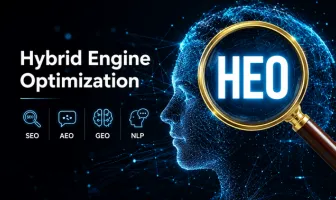
Hybrid Engine Optimisation (HEO) combines traditional SEO with AI-driven strategies to maximise visibility across search engines and AI platforms. It integrates AEO, GEO, and NLP techniques to ensure content is optimised for both human users and AI tools. Implementing HEO is essential for staying competitive in the evolving digital world.
The digital landscape is evolving faster than ever. This requires the search engines used to find information in the vast digital ocean to become equally advanced. Gone are the times when people could simply enter their queries and wait for the engine to show them what they were looking for. Nowadays, the advancement in AI search and voice queries makes the ranking criteria even more complicated and harder to understand.
This is why hybrid engine optimisation (HEO) is becoming an increasingly important approach in recent years. HEO refers to the combination of the tried-and-tested SEO strategies and the latest AI technologies available on the market. In a nutshell, HEO allows us to benefit from the strengths of both approaches and create something even more powerful, namely, generative AI visibility alongside the conventional SEO techniques.
In this blog, let’s explore everything about HEO that you need to know to stay ahead of your competitors. Let’s get started.
SEO has changed a lot over the years. The initial SEO strategy involved keyword stuffing, where keywords would be used frequently and strategically in content for higher search engine rankings. However, as search engines grew more advanced through subsequent updates, so did their SEO tactics.
Modern search engines use artificial intelligence technology that understands the intent behind language. Therefore, companies that continue to depend on SEO techniques alone without considering the role of AI-powered search engines are at a disadvantage.
As a result, HEO has emerged. The combination of AI technology and natural language processing helps search engines comprehend content better.
Today, successful SEO agencies are embracing HEO to stay ahead of the curve. As a leading SEO agency in India, Blacklisted has adopted this innovative approach to ensure that our clients get the maximum benefit from both traditional SEO and the AI-powered search engines driving the digital experience.
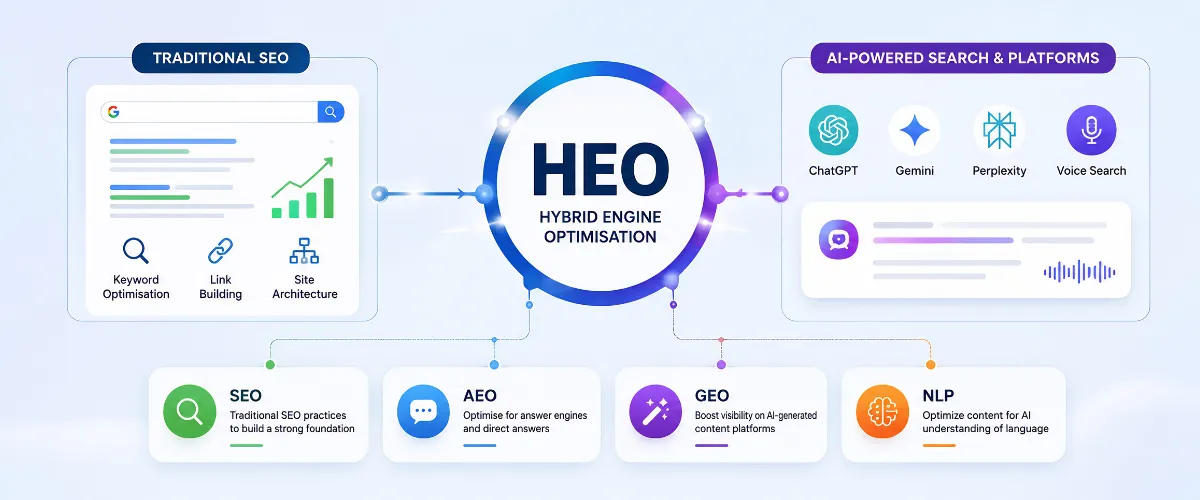
Hybrid Engine Optimisation (HEO) is an advanced SEO approach that combines traditional search engine optimisation with AI-focused optimisation techniques. It goes beyond ranking content on search engines like Google and Bing by also considering how content is discovered, interpreted, and surfaced by AI-powered platforms such as ChatGPT, Gemini, Perplexity, voice search tools, and other generative search systems.
In simple terms, HEO helps businesses optimise their content for both conventional search engines and modern AI-driven discovery platforms. You can think of it as a Hybrid AI SEO Strategy that blends proven SEO fundamentals—such as keyword targeting, technical optimisation, and high-quality content—with newer tactics designed to improve visibility in AI-generated answers, conversational search, and recommendation-based search experiences.
The goal of HEO is simple: to ensure that your content not only ranks in traditional search results but also gains visibility across AI-powered search platforms where users increasingly discover information today.
HEO combines several core strategies:
More core pillars of HEO will be discussed later in the blog.
HEO provides several advantages for businesses that seek to maximise their online visibility:
To understand how the SEO approaches vary from each other, here is a concise comparison between traditional SEO, AEO, and HEO:
| Factor | SEO (Search Engine Optimisation) | AEO (Answer Engine Optimisation) | HEO (Hybrid Engine Optimisation) |
|---|---|---|---|
| Focus | Focuses on ranking content in traditional search engines like Google, using SEO strategies like keyword optimisation, backlinks, technical SEO, etc. | Optimises content specifically to appear in direct AI-generated answers, including snippets, voice searches, FAQs, and AI systems such as ChatGPT and Gemini. | Combines SEO, AEO, and GEO strategies to achieve maximum visibility across traditional search engines and AI-driven platforms. |
| Primary Goal | Rise up on search engine result pages (SERPs) and get traffic for your website using conventional search techniques. | Be seen as part of the answer within the AI-powered search results, which will help you gain visibility in search engines, featured snippets, ChatGPT responses, AI search tools, and voice search. | Achieve visibility across all platforms (search engines, AI tools, AI overviews, voice search, featured snippets, knowledge panels, and AI-driven platforms like ChatGPT) by integrating both traditional and AI-based SEO strategies. |
| Content Strategy | Content is typically optimised with regard to keywords, backlinks, and internal linking. | Content is optimised to provide concise answers and is structured in a way that AI tools can pull directly for responses. | Build content clusters around a main topic with supporting subtopics to build topical authority. Organise content for human users and AI-powered platforms. |
| Optimization Technique | Keyword optimisation, backlink building, and technical SEO (site speed, mobile optimisation, etc.). | Schema markup (FAQ, How To, Articles, etc.), short answer paragraphs, and structured data to help AI extract direct answers. | Includes SEO basics, AEO, GEO, NLP, and AI-based content formatting. |
| Target Audience | Human users, primarily through traditional search engine rankings. | AI models like Google’s featured snippets, voice search, and AI-driven chatbots. | Both human users and AI models (Google’s AI, ChatGPT, voice search, etc.) |
HEO starts with the basics, as strong SEO fundamentals are essential for ensuring long-term performance.
Why it matters: In spite of the growing prominence of AI in SEO, these foundational practices form the backbone of any successful HEO strategy. Without them, it will be difficult for AI-focused optimisation to yield long-term results.
Answer Engine Optimisation (AEO) emphasises how content is formatted to be easily extracted by AI algorithms.
Why it matters: AEO makes it easy for AI search engines, like Google’s featured snippets or ChatGPT, to pull relevant, concise answers from your content. Hence, aid in boosting visibility in AI-driven search features.
One of the crucial pillars of SEO that remains highly valuable and relevant is E-E-A-T. This stands for Experience, Expertise, Authority, and Trustworthiness, and they are all essential elements for ranking in both traditional and AI-powered search engines.
How to do it:
Why it is important: Search engines and AI-driven tools reward content that demonstrates authority and trust. This increases the chances of ranking higher and being cited by AI platforms.
AI tools understand context as well as keywords. This makes semantic SEO essential. Semantic SEO strategy focuses on creating comprehensive content regarding a topic or an entity, rather than focusing on targeting a keyword. In other words, it involves learning about the context and the meaning behind a particular term, making it possible for search engines to present more relevant results to the user.
What to do:
HEO extends visibility beyond the traditional SERP to AI-powered platforms like voice search, knowledge panels, and AI tools such as Perplexity. For this, ensure your content is discoverable not just in search engines but also across platforms like Google AI overviews and voice search results.
Why it matters: With AI search tools on the rise, HEO ensures that your content is visible across all relevant discovery surfaces.
AI-based systems like ChatGPT and Gemini pay more attention to the topic-specific authority of your website rather than just individual web pages.
What to do:
Why it matters: The more comprehensive your content clusters are, the more likely your site will be seen as an authoritative source. This will help boost your rankings in AI-driven search results.
While traditional SEO focuses on keywords, HEO emphasises the use of tangible entities, such as people, brands, products, or concepts.
What to do:
Why it matters: AI tools identify entities, not just keywords. When your brand is properly defined and linked to these entities, AI models can accurately understand and rank your content.
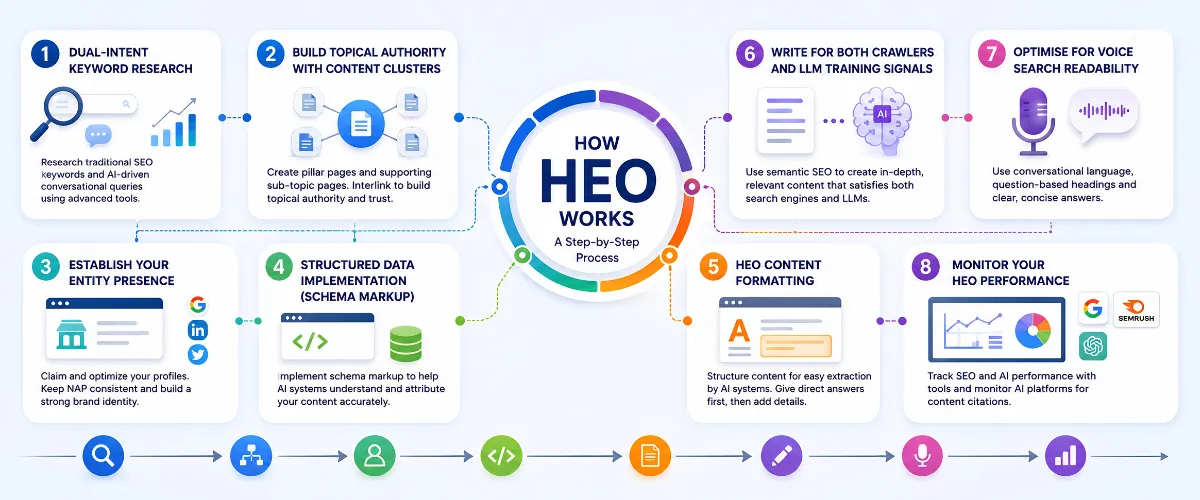
You’ve just learnt the core pillars of HEO and what they strive to achieve for ranking and visibility. Now, let’s take a look at the step-by-step process in a nutshell of how we at Blacklisted recommend implementing these:
Start by researching both traditional SEO keywords and AI-driven conversational queries. Use tools like Semrush, Ahrefs, and AlsoAsked in order to identify long-tail and query-based keywords. It allows attracting traffic from both traditional and AI-powered search engines like Google and ChatGPT, respectively.
Establish topic authority through building your pillar pages together with additional sub-topic pages to support them. Ensure interlinking of pages to establish your expertise with both Google and AI models.
AI models prioritise entities. Claim your Google Business Profile, keep your NAP data accurate and consistent, and make sure your social media profiles and author bios reflect your brand identity.
Utilise schema markup so that AI systems can readily understand and attribute your content. Ensure that your website has the FAQ schema, Article schema, and Organisation schema.
Organise your content in a way that facilitates the extraction of answers directly from the text by AI systems. The process entails having direct answers right at the start of each segment, followed by elaborations.
Use semantic SEO principles to write content that demonstrates depth, relevance, and consistency. Refrain from keyword stuffing and focus on context-driven language to satisfy both Google crawlers and Large Language Models (LLMs) like GPT-4, Gemini 3 Pro, etc.
As voice search is based on human conversation, create the content in such a way that it includes question-based sub-headings and responses in an easy-to-read fashion.
Track both SEO and AI performance using tools like Google Search Console and Semrush, and manually check AI platforms like ChatGPT and Perplexity for your content citations.
Here at Blacklisted, we strive to be one step ahead when it comes to SEO and digital marketing strategies. We have fully embraced HEO approach in order to guarantee that not only will our clients get rankings on conventional search engines, but they will also be visible in the AI-powered search systems. We keep strengthening our clients’ trust in us as an SEO agency that keeps upgrading.
By integrating AEO, GEO, and NLP techniques, we ensure that our content is optimised for traditional search engines and AI-driven platforms. This combination enables us to maximise both generative AI visibility and organic search traffic, giving our clients a competitive edge in the ever-changing digital world. Reach out to us to learn how we can take your SEO and AI visibility to the next level.
Hybrid Engine Optimisation is the future of SEO. It bridges the gap between SEO and GenAI visibility. Through the integration of traditional SEO techniques with AI-powered search, AEO, and GEO, businesses can maximise their online visibility across all platforms, including search engines and AI-powered tools. At Blacklisted, we utilise the HEO method to ensure that our clients are not only visible but visible in places where it counts: on all AI and search engine platforms.
If you’re looking to stay ahead in the digital world, now is the time to embrace HEO and ensure your content reaches its full potential.

We are your go-to source for everything digital. We cover marketing tips, design trends, new tech, and how to build your brand. Every post has useful information to keep you updated and ready to tackle the digital world. It’s not just articles; it’s a way to learn, grow, and connect with others navigating the same digital journey.