case study


Omnichannel marketing means delivering a seamless experience regardless of the online or offline platform used. Email, social, website, in-store, etc. overlap to form a seamless journey for the customer. When done right, it boosts engagement, increases retention, and makes your brand unforgettable. For a business to remain relevant, building a seamless customer journey is not a discussion, it's necessary.
What Is Omnichannel Marketing, Really? Let’s break it down.
Omnichannel marketing is defined as a strategy where all customer touchpoints: social media, email, your website, brick-and-mortar locations, mobile apps, etc., interact in a cohesive and connected brand experience. Omnichannel marketing is not just being present on multiple channels. It is a commitment to making those channels talk to each other, so the customer does not have to repeat any information or start over at each point.
It means your Instagram ad matches your website offer. Your customer support representatives already have insights on the product someone added to their cart last night. Your in-store staff member has the same information your chatbot gave an hour ago.
It’s one experience, not multiple disconnected experiences.

Here’s where brands usually miss the mark.
Multichannel means your brand is present on multiple platforms—for example, your brand exists in a store, an app, a website, and a few social handles—but each channel functions in a silo.
Omnichannel means all those touchpoints are connected. The conversation is ongoing wherever your customer goes. That’s what customers expect today—and that’s where the magic (and ROI) happens.
Customer behaviour has evolved, and quickly.
Today’s buyers:
A smart digital marketing approach no longer starts with “Where are all our points visible?” It starts with “Where is the customer—and what do they currently need?”
As a full-service creative agency, we’ve seen first-hand how brands that align messaging, tone, and experience across multiple platforms, outperform those that treat each channel as a standalone campaign.
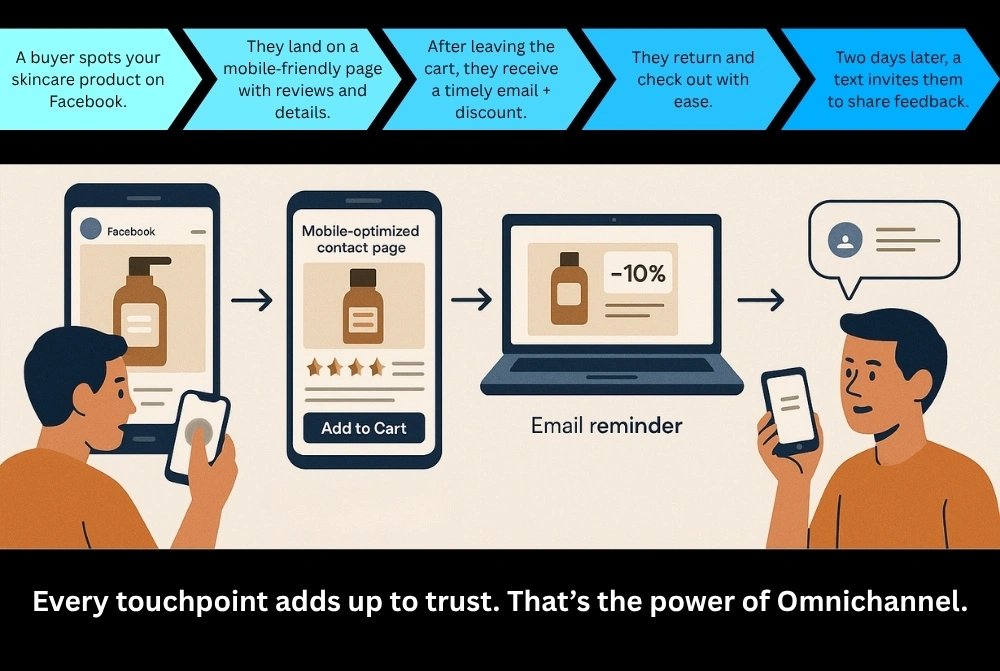
Let’s assume: A buyer clicks through a Facebook ad for your new skincare product. They find a mobile optimized contact page with good information and reviews. They add the product to their cart but don’t purchase right away. Later, they receive an email to remind them of the abandoned cart, including a small discount. They complete their purchase. Two days after delivery, they receive a text asking for a review.
At every step, the tone is consistent. The message is timely. And the brand feels like a thoughtful, well-oiled machine.
That’s omnichannel in action.
Here’s why it matters:
You don’t need to launch everything at once. Start with these building blocks:
Map out your typical customer journey. Where do they discover you? Where do they convert? Or where do they drop off? This helps prioritise touchpoints that matter most.
Make sure every channel speaks the same language—from headlines and visuals to tone and timing. A creative agency can help audit and align your content across the board.
Use CRMs, CDPs, or integrated tools to ensure data sync across email, ads, chat, and offline. Choose systems that help your platforms “talk to each other.”
Mobile-first design is non-negotiable. Most omnichannel journeys start or end on mobile. Responsive design, fast loading times, and simple CTAs matter. With approx. 20.5% of users using voice search, brands need voice-ready content.
Plan content for awareness through retention—blog posts, social, reminders, tutorials—with consistent voice. All should feel like chapters of the same story.
Even the best brands stumble. Here are pitfalls to dodge:
Yes! Because they support each other.
When you blend both, you get messaging that feels timely, contextual, and human—whether the user is opening an email or visiting your store.
We’ve worked with brands that increased retention rates by 20%+ just by syncing their social, email, and website journeys.
Others have seen cost-per-acquisition drop when remarketing was tied to a connected CRM.
Whether you’re B2C, B2B, or hybrid—the playbook is the same: meet your audience where they are and make the journey feel effortless.
Voice search, shoppable reels, smart TV ads, in-store QR experiences—platforms will keep multiplying. But customer expectations will stay the same:
Make it smooth, make it personal, make it feel like one brand.
Creative agencies that understand both the tech and the human side of digital marketing are best positioned to lead this shift.
Today, omnichannel isn’t just a marketing trend. It’s your brand’s operating system.
If your customer has to start from scratch every time they switch platforms, you’re not just losing sales—you’re losing trust.
Start small. Connect two platforms. Then expand. Let each campaign become part of a larger conversation.
Want to build seamless journeys across channels? Let’s connect!
Blacklisted isn’t just a digital marketing team—we’re your creative agency for building brand experiences that actually feel connected.

We are your go-to source for everything digital. We cover marketing tips, design trends, new tech, and how to build your brand. Every post has useful information to keep you updated and ready to tackle the digital world. It’s not just articles; it’s a way to learn, grow, and connect with others navigating the same digital journey.