case study


Hybrid AI SEO helps your content perform across Google, AI search platforms, voice search, and answer engines. The goal is simple: write useful human content, structure it clearly, and make it easy for AI systems to understand. With the right mix of AI SEO, AI optimisation, and content strategy, brands can build lasting authority in modern search.
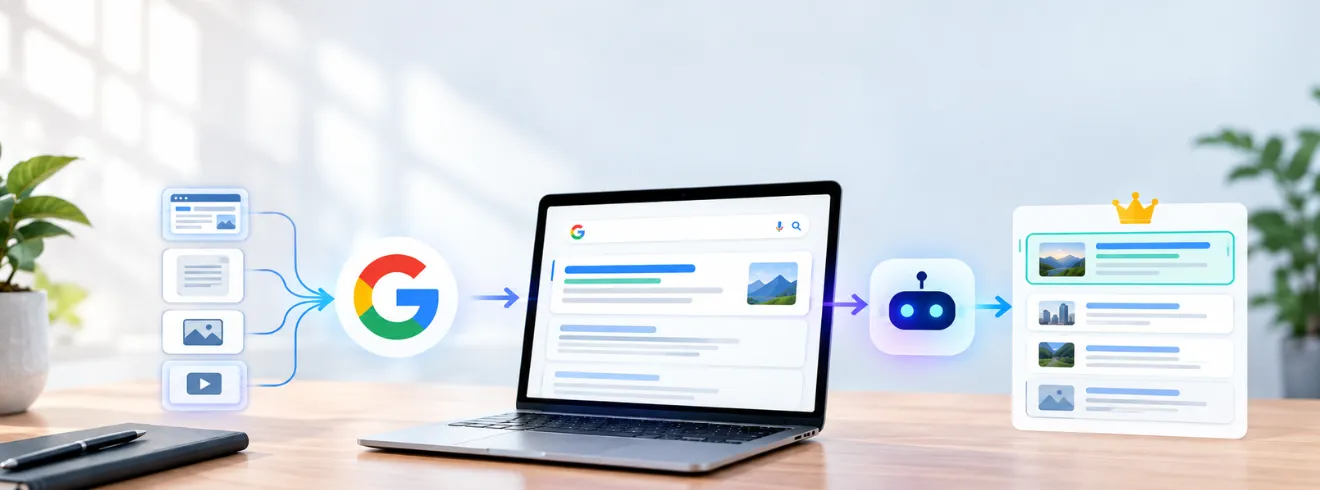
Search has changed. People no longer rely only on Google they also ask questions on ChatGPT, Gemini, Perplexity, and other AI-powered search platforms. A Hybrid AI SEO strategy combines traditional SEO with AI search optimisation techniques like Answer Engine Optimisation (AEO), Generative Engine Optimisation (GEO), semantic SEO, and structured data to improve visibility across both search engines and AI assistants.
As AI-generated answers become a primary way people discover products, services, and brands, ranking on Google alone is no longer enough. Businesses need content that can rank in organic search, appear in Google AI Overviews, and be referenced by AI models that provide direct answers. The brands that adapt to this shift are more likely to earn qualified traffic, build authority, and stay competitive in the evolving search landscape.
In this guide, you’ll learn what a Hybrid AI SEO strategy is, why it matters in 2026, how it differs from traditional SEO, and the practical steps you can take to increase your visibility across Google Search, AI search engines, voice search, and conversational AI platforms—while creating content that delivers real value to your audience.
Hybrid AI SEO expands traditional search optimisation to match the way people search today. Instead of focusing only on Google rankings, it helps your content become discoverable across search engines, AI assistants, voice search, featured snippets, and answer-based search experiences.
This approach is built on the principles of Hybrid Engine Optimisation (HEO), combining proven SEO fundamentals with AI-focused optimisation techniques. It emphasises semantic relevance, topical authority, structured data, entity optimisation, and answer-first content so both search engines and AI models can accurately understand, interpret, reference, and recommend your content across traditional and AI-powered search experiences.
Before building a hybrid AI SEO strategy, it is important to understand these terms first:
| Term | Meaning |
|---|---|
| AI SEO | AI SEO means optimising your website and content for traditional search engines as well as for AI-driven discovery. It emphasises clarity, structure, relevance, and authority. |
| AI Search | It refers to artificial intelligence-driven search experiences, which include tools such as ChatGPT, Gemini, Perplexity, Google AI Overviews, and others where direct answers are given instead of just linking to sources. |
| AI Optimisation | AI optimisation means improving your content in order for AI systems to understand it. This is achieved by having headings clearly defined, giving direct answers to questions, implementing schema markup, keeping information up to date, and maintaining strong topical coverage. |
| AIO | AIO, or Artificial Intelligence Optimisation, focuses on getting your brand, website, and content ranked highly on AI engines. It shifts the focus from traditional rankings to how AI tools read, summarise, and recommend content. |
| LLMO | LLMO, or Large Language Model Optimisation, is the process of optimising content for large language models (LLMs) such as OpenAI’s GPT, Google Gemini, and Anthropic’s Claude. It helps AI systems recognise your brand, expertise, services, and authority. |
| Answer Engine Optimisation (AEO) | AEO is about creating content that directly answers users’ questions. It helps content appear in featured snippets, voice search responses, and other answer-based search results. |
| Generative Engine Optimisation (GEO) | GEO means preparing your content for AI platforms that generate responses from multiple sources. It focuses on original insights, structured information, clear context, and strong credibility signals. |
A strong SEO strategy for AI ranking is about knowing where AI can support the process and where human strategy, experience, and brand understanding must lead.
Here are the steps to follow:
The first thing that you should do before utilising AI tools or prompts is determine what hybrid means to your business.
Begin by outlining what your primary SEO and business goals are. These may include increasing organic traffic, generating leads, enhancing topical authority, amplifying branded search, or ranking in AI answers. Depending on the goal you set, this will further guide the structure and approach your Hybrid AI SEO strategy will take.
Next, determine how you would like AI incorporated into the workflow.
AI can support:
However, strategy, brand voice, creativity, cultural nuance, fact-checking, and final publishing should all remain the domain of humans. AI is used as a way to increase productivity and efficiency but not to replace thought processes.
First, look at where your website is today, before anything else is built.
For SEO, conduct an audit of your technical health, rankings, content gaps, internal links, page experience, and E-E-A-T signals. This entails performing audits of your About page, bios, references, service pages, case studies, content, and structure.
For AI, make a list of the tools you use today. These may include ChatGPT, Gemini, Surfer, Frase, Semrush, or any number of AI-supported platforms. Then, examine what each tool is doing for you right now and what you would like the tool to do.
This step helps you understand:
Proper auditing makes your AI SEO strategy a disciplined practice. Without this, it’s very easy for AI optimisation to become a series of unrelated activities rather than a systematic approach to growth.
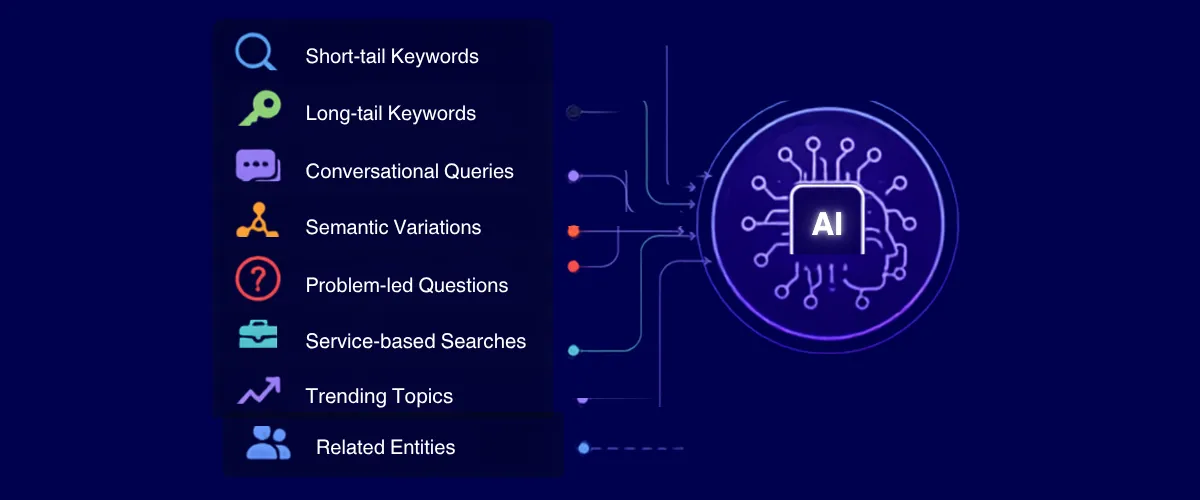
The initial component of hybrid AI SEO is improved research.
Traditional keyword research is still important, but AI has changed how people ask questions. People aren’t just searching for short phrases anymore. Instead, they’re posing detailed, full, natural language questions to sources like Google, ChatGPT, Gemini, Perplexity and other platforms.
That means your research should include:
AI-supported tools can help collect and group this information faster. But the final clustering still needs human judgement.
For example, AI may group keywords by similarity, but we refine them based on real user journeys, business intent, content depth, and brand positioning. This helps create proper content hubs instead of scattered blogs.
The final output should be a clear topical map. Each cluster should support a larger theme and help the website build authority around subjects that matter to the audience.
EEAT stands for ‘Experience, Expertise, Authoritativeness, and Trustworthiness’ and is used by Google to rate the credibility and quality of content. First-hand insights, industry examples, client-side observations, and original frameworks make the content more useful and trustworthy.
That is why E-E-A-T should be built into the brief before writing begins, not added as an afterthought.
Do not jump straight into drafting. A strong Hybrid AI SEO process starts with detailed content briefs. AI can help analyse top-ranking pages, common headings, FAQs, entities, search intent, and content gaps.
But the brief should not stop there. A strong content brief should include:
This is where human expertise matters most. For complex topics, AI may help organise the structure, but it cannot invent real experience.
The most effective Hybrid AI SEO workflow is not AI-only. It is a loop where AI supports the process, and humans guide the quality.
A practical workflow looks like this:
This is the core of Hybrid AI SEO. AI does the heavy lifting, but humans make the content trustworthy, useful, and original.
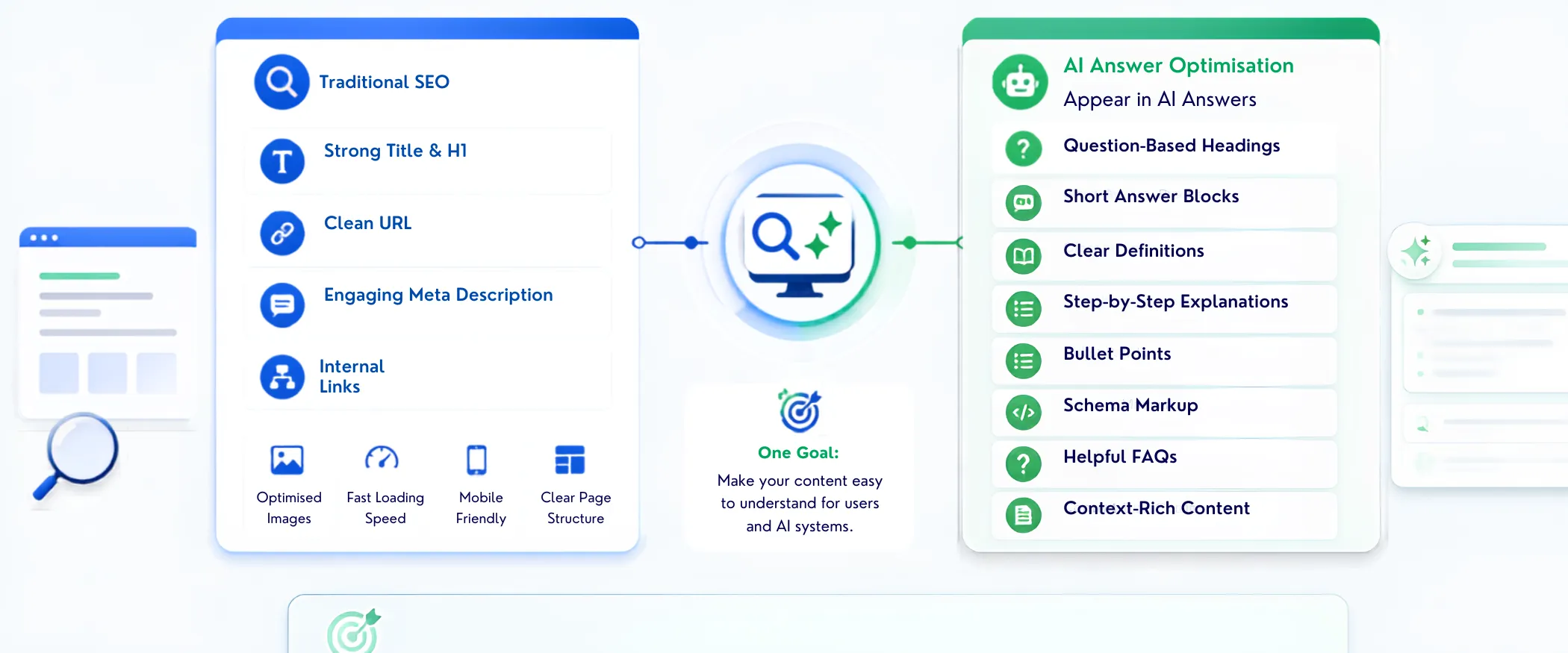
A Hybrid AI SEO strategy should support both classic search rankings and AI answer visibility.
For traditional SEO, focus on:
For Answer Engine Optimisation, focus on:
The goal is to make every important section easy to understand. Try to make the content layered, starting with the most definitive answer, and then expanding on this with further information if necessary. This also helps optimise content for voice search, improves the page’s ranking with search engines, and increases certainty within AI systems reading the page.
Hybrid AI SEO is not limited to what you have posted on your site. AI systems and search engines also evaluate broader trust signals to determine your authority. These include backlinks, brand mentions, reviews, citations, social media profiles, business directories, guest posts, interviews, and other third-party references.
Whether you manage SEO in-house or work with an experienced SEO agency, building and maintaining a strong authority ecosystem is essential for long-term visibility in both traditional search and AI-powered search.
Your brand must also be consistent in terms of its presence across the key platforms. Your author bios, LinkedIn profile, service pages, Google My Business page, and other mentions across the Internet should give an idea of who you are and what you offer and provide credibility to your content.
Which is why social media is an indispensable part of an overall strategy.
The use of efficient social media management services will allow your published content to get better reach by managing consistency and helping build brand credibility among your audience.
Measurement is where many AI SEO strategies become weak. Traditional SEO tracking is still needed. You should monitor organic traffic, rankings, impressions, click-through rate, engagement, conversions, and content performance by topic cluster.
But Hybrid AI SEO also needs AI visibility tracking, like:
When your AI-driven SEO strategy is repeatable, it grows more powerful. Build easy-to-follow SOPs for each step in your workflow, from keyword research to content clustering to brief writing, drafting, optimisation, publishing, and tracking. Clearly outline in each SOP what’s being handled by AI and what needs to be reviewed by humans.
You can also build prompt libraries for:
People now discover brands in more ways than before. A potential customer might ask Google for recommendations, query ChatGPT, search on social platforms and review pages and visit the brand’s website, already having an opinion of the brand. This means brand visibility can no longer depend on one platform, one keyword set, or one content format.
Hybrid AI SEO helps brands build visibility on both AI and conventional search, on answer engines and across digital domains, combining the expertise and processes of SEO, AI optimisation, content planning, E-E-A-T, authority building and human-led brand thinking.
It matters because it helps businesses:
Hybrid AI SEO is not about replacing human strategy with AI. It’s about using AI where the value is, like speeding things up, adding structure, providing insights, and allowing humans to control the originality, brand voice, expert opinion, and final approval.
With today’s brands, visibility is now a multi-faceted construct involving keywords, rankings, usefulness for users, comprehensibility for search engines and being structured enough for an AI-driven search experience. The overall purpose does not change; the drive for brands to be discoverable, understandable, and referencable throughout modern search experiences still exists.
At Blacklisted, we provide brands with the visibility of the future and enable brands to build great SEO, content strategy, AI workflows, branding and social media management services. As the best digital marketing agency for brands seeking more intelligent digital growth, we help bridge the gap between traditional search and the power of AI discovery.

We are your go-to source for everything digital. We cover marketing tips, design trends, new tech, and how to build your brand. Every post has useful information to keep you updated and ready to tackle the digital world. It’s not just articles; it’s a way to learn, grow, and connect with others navigating the same digital journey.