case study

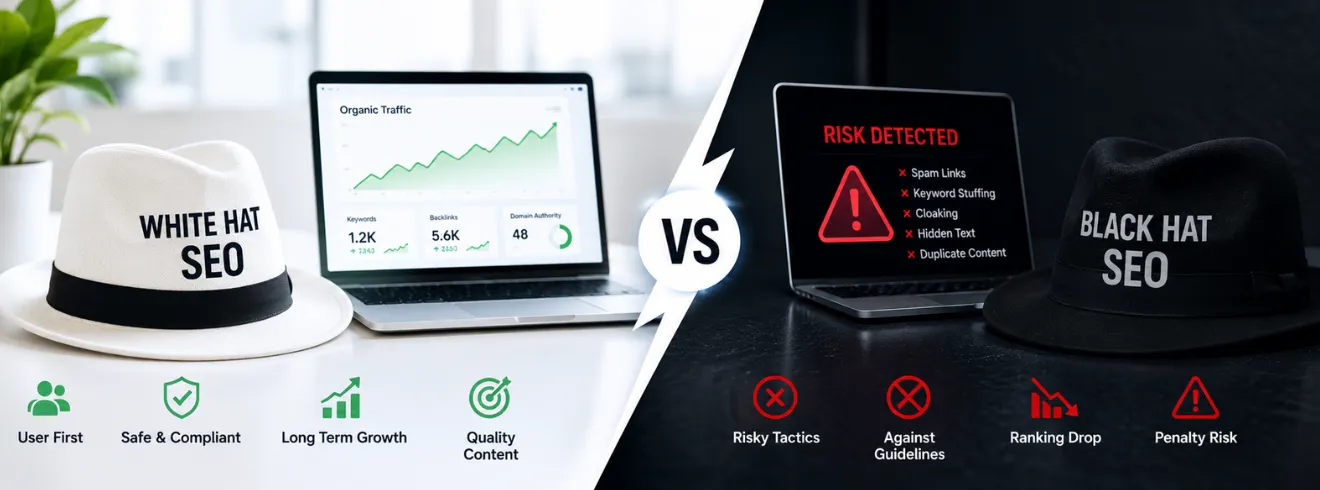
The difference between white hat and black hat SEO comes down to one thing: long-term trust versus short-term shortcuts. White hat methods build stable rankings through helpful content, technical quality, and ethical optimisation, while black hat methods try to manipulate search engines and can damage visibility, traffic, and brand reputation.
White hat SEO refers to search engine optimisation techniques that follow Google’s guidelines and focus on long-term growth through quality content, technical improvements, and a better user experience. Black hat SEO, by contrast, uses manipulative tactics such as keyword stuffing, cloaking, and spammy backlinks to gain faster rankings, often at the risk of penalties. While both aim to improve visibility, white hat SEO builds sustainable organic growth, whereas black hat SEO can damage rankings, trust, and long-term website performance.
In this guide, we break down the difference between white hat and black hat SEO, the tactics behind each approach, and which strategy is better for long-term business growth.
White hat SEO refers to optimisation practices that follow Google’s guidelines and focus on improving a website in ways that benefit real users. Instead of using shortcuts to manipulate rankings, it aims to grow visibility through high-quality content, relevant keywords, strong site structure, technical SEO, and a better user experience.
In simple terms, white hat SEO is about building rankings the right way. It helps websites earn organic traffic through useful content, trust, and long-term search performance rather than risky tactics that can lead to penalties.
Black hat SEO refers to tactics used to manipulate search engine rankings in ways that go against Google’s guidelines. Instead of improving a website for users, it focuses on exploiting loopholes through methods like keyword stuffing, cloaking, hidden text, spammy backlinks, and other deceptive practices designed to generate quick results.
While black hat SEO may create short-term ranking gains, it comes with serious risks. These tactics can lead to penalties, ranking drops, loss of trust, and long-term damage to a website’s search performance.
| Point of Difference | White Hat SEO | Black Hat SEO |
|---|---|---|
| Main approach | White hat SEO focuses on improving a website in ways that benefit real users. It follows search engine guidelines and builds rankings through quality content, relevance, technical improvements, and trust. | Black hat SEO focuses on manipulating rankings through shortcuts and loopholes. It prioritises quick gains over user value and often ignores search engine rules in the process. |
| Content quality | Content is original, useful, and created to satisfy search intent. It gives users meaningful information, improves engagement, and supports long-term rankings. | Content is often thin, duplicated, auto-generated, or stuffed with keywords. It may rank for a short time, but usually offers little value and performs poorly over time. |
| Keyword usage | Keywords are used naturally in headings, titles, meta tags, and body content to improve relevance without harming readability. | Keywords are repeated unnaturally to force rankings. This can make the content feel spammy, reduce readability, and trigger search quality issues. |
| Link building | Links are earned through strong content, genuine outreach, relevant placements, and authority-building strategies. | Links are often bought, exchanged in bulk, generated through private blog networks, or placed on irrelevant low-quality sites to manipulate authority signals. |
| User experience | The website is designed to be fast, mobile-friendly, easy to navigate, and genuinely helpful for visitors. SEO improvements often support both rankings and usability. | User experience is usually ignored. Tactics such as hidden text, doorway pages, sneaky redirects, or misleading pages can frustrate users and damage trust. |
| Risk level | It is a safer and more stable strategy. Results may take longer, but they are less likely to disappear after algorithm updates. | It is highly risky. Rankings can drop suddenly, traffic can collapse, and the site may face manual actions or removal from search results. |
| Time frame | White hat SEO is built for long-term growth. It improves visibility gradually and creates a stronger foundation for sustainable organic traffic. | Black hat SEO usually aims for short-term wins. It may bring quick traffic spikes, but those gains are often unstable and difficult to maintain. |
| Business impact | It supports stronger brand credibility, better-quality traffic, higher trust, and long-term search authority, making it ideal for serious business growth. | It can damage brand reputation, waste marketing budget, and create long-term visibility problems that are expensive to fix later. |
| Compliance with Google guidelines | White hat SEO aligns with Google’s guidelines and focuses on making the website more relevant, trustworthy, and useful for users. | Black hat SEO violates Google’s guidelines by using deceptive tactics to influence rankings unfairly and bypass best practices. |
| Ranking stability | Rankings are generally more stable because they are supported by quality content, technical SEO, and authority built over time. | Rankings are often unstable because they depend on tactics that can stop working quickly or trigger penalties after algorithm updates. |
| Trust and brand reputation | It helps build trust with both users and search engines, supporting stronger engagement and long-term brand credibility. | It can weaken trust if users land on misleading, spammy, or low-value pages, which may also hurt conversions and brand perception. |
White hat tactics help a business move forward without putting its website at risk. When people search online, they are basically looking for plain answers, solid details, and pages that feel dependable. Search engines also aim to show search results that truly meet user intent. That’s the reason ethical SEO ties visibility and user experience together.
A business that follows white hat methods can build:
This approach may take time, but it yields results that are far more dependable.
Brands that partner with a trusted SEO agency understand that ranking is not the sole objective. The agency way is to look into how the user perceives, navigates, trusts, and interacts with the website.
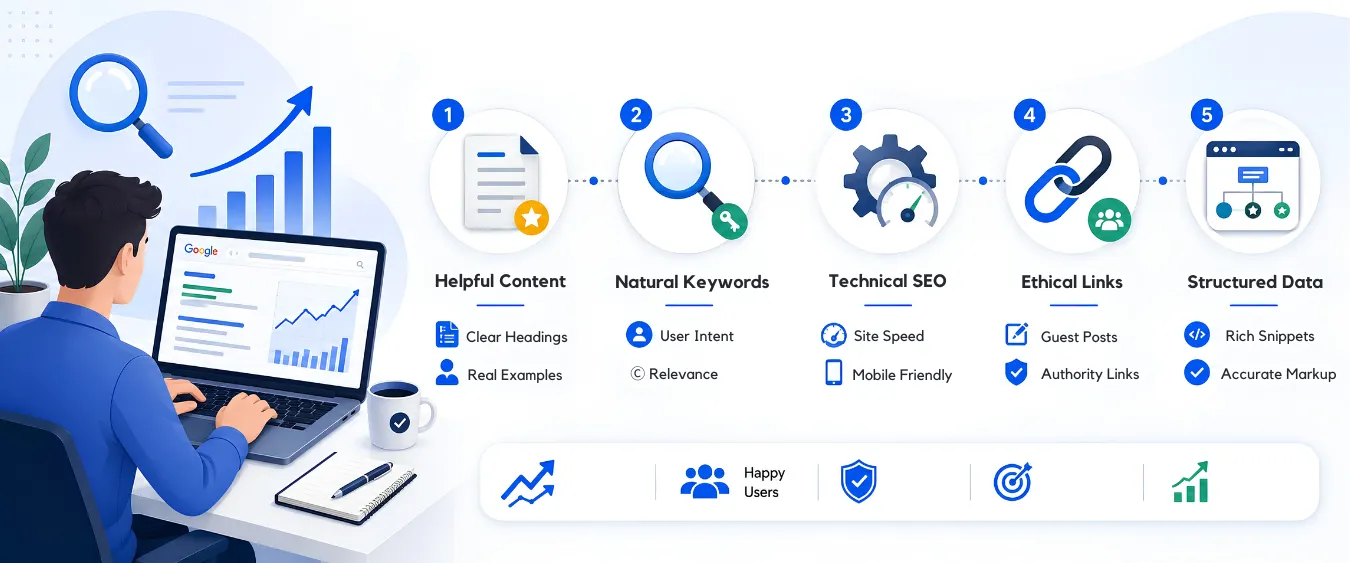
Ethical SEO is not complicated when the basics are done properly. It focuses on making the website more useful, accessible, and search-friendly.
What is good SEO content really? It starts when the content is able to answer what people are searching for in the first place. It should be original and laid out in a way that makes sense and be able to genuinely help the user’s query.
This means that your blogs, your service pages, and even your landing pages shouldn’t be written only around keywords. Instead, they should tackle uncertainties, respond to the common questions, and quietly lead the reader to the next step, which is getting them to take action.
A helpful content page usually includes:
At Blacklisted, we focus on content that works for both search engines and readers. That balance is what gives SEO meaning. Creating content that performs well also requires attention to effective headlines and strategic keyword research, helping businesses improve visibility, clicks, and user engagement.
Keyword research helps you get a feel for what your audience is actually searching for. But keywords should never be shoved into every sentence. They should show up in a natural way in titles, headings, meta descriptions, the page body, URLs, and even image alt text when it fits.
For example, if your page is about white hat and black hat SEO, then the writing should really cover the whole thing, not just echo the exact phrase. In other words, it should go deeper and add value rather than sounding mechanical. Search engines now handle context way better, so the goal is not keyword stuffing but relevance.
Technical SEO helps search engines crawl, understand, and index your website properly. Even the best content can struggle if the website has technical issues.
Important technical areas include:
Technical SEO also improves user experience. If your site loads slowly or feels hard to use, visitors may leave before reading anything. That can affect both engagement and conversions.
Links still matter in SEO, but the quality of those links matters far more than the quantity. Ethical link building means earning links through useful content, genuine collaborations, strong resources, and relevant digital PR.
This can include:
Black hat SEO refers to the use of questionable techniques that involve manipulation in order to improve search engine rankings while disregarding the rules.
Such techniques are usually designed with quick profits in mind rather than long-term growth. They try to exploit loopholes instead of improving the website for real users.
The main purpose of black hat SEO is usually to gain fast rankings. Some businesses use it because they want quick traffic, quick leads, or quick visibility. But the risk is serious.
A website using black hat methods may face ranking drops, manual penalties, loss of trust, or even removal from search results. This is why businesses should be careful when choosing SEO support. If a provider promises instant rankings with no clear process, that is a warning sign.
Using structured data allows search engines to understand your content more accurately. It may allow you to get rich snippets for articles, FAQs, products, reviews, and many other pages. Nonetheless, it should always represent your actual content.
For example, if the page contains FAQ markup, the questions and answers must be displayed on that page. Similarly, if you use a review schema, it must be authentic.
Honest structured data improves clarity. Using false data leads to manipulating search engines. This is what brings us to the unethical side of SEO, next.
you to get rich snippets for articles, FAQs, products, reviews, and many other pages. Nonetheless, it should always represent your actual content.
For example, if the page contains FAQ markup, the questions and answers must be displayed on that page. Similarly, if you use a review schema, it must be authentic.
Honest structured data improves clarity. Using false data leads to manipulating search engines. This is what brings us to the unethical side of SEO, next.
Black hat SEO refers to the use of questionable techniques that involve manipulation in order to improve search engine rankings while disregarding the rules.
Such techniques are usually designed with quick profits in mind rather than long-term growth. They try to exploit loopholes instead of improving the website for real users.
The main purpose of black hat SEO is usually to gain fast rankings. Some businesses use it because they want quick traffic, quick leads, or quick visibility. But the risk is serious.
A website using black hat methods may face ranking drops, manual penalties, loss of trust, or even removal from search results. This is why businesses should be careful when choosing SEO support. If a provider promises instant rankings with no clear process, that is a warning sign.
Black hat methods may look tempting because they promise speed. But they can damage everything a business has built online.
Search engines keep improving their systems to detect manipulation. What works for a few weeks can become a major problem after the next update.
The risks include:
A business should not risk long-term brand value for short-term ranking tricks. This is one reason our experts at Blacklisted always recommend ethical SEO foundations before aggressive growth efforts.
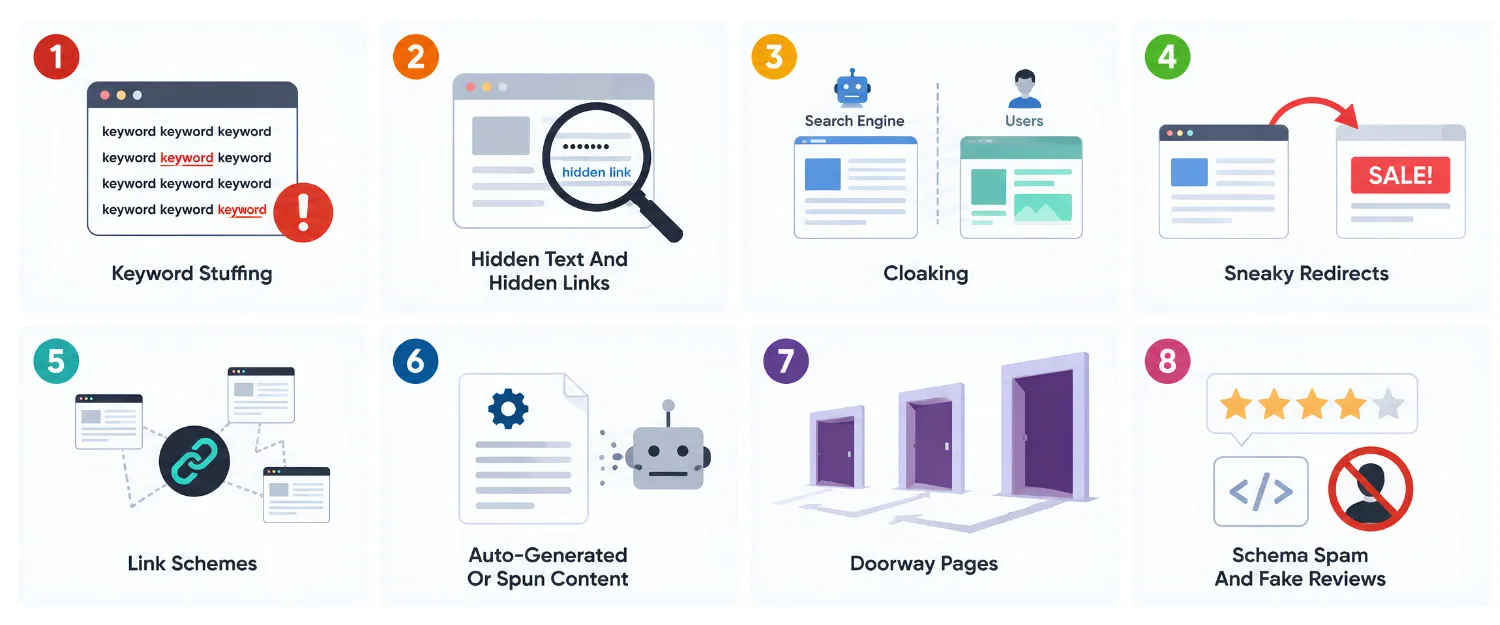
Keyword stuffing refers to the overloading of web pages with keywords that don’t fit there at all. This makes content hard to read and unpleasant for users.
When readers find the same keyword in every other line, the page starts looking more spammy than useful. This practice makes no use of context and instead uses keywords as clutter.
Hidden text refers to putting links or keywords in places that people can’t see. It may involve matching the colour of the text to that of the background or using very small fonts.
The goal is to show the text only to the search engines, which the users can’t see. Such practice is deceptive, and it can lead to penalties.
This involves presenting one version of your web page to search engines and another to users. This is done with the aim of ranking in certain queries while providing something completely different to users.
Search engines treat cloaking as a serious violation mainly because it breaks user trust as they don’t get what the search result had promised.
A redirect is not always bad. Redirects are useful when pages move or URLs change. But sneaky redirects are different. They send users to a page they did not expect.
For example, a search result may promise an informational page but send the user to an unrelated sales page. This creates a poor user experience and can damage rankings.
Link schemes include buying links, joining link farms, using private blog networks, or exchanging links at scale, only to manipulate rankings.
These links are not earned because of quality. They are created only to pass the ranking value. That is risky.
Auto-generated content is often created in bulk without much worth. The spun content is generated from the available content by altering words so that it looks unique. However, in most instances, it turns out to be of poor quality and without any added value. This type of content may target long-tail keywords, but it does not help users.
Search engines have become more efficient at recognising poor-quality content, duplication, and mass content production. Hence, spinning content can harm the page’s credibility.
Doorway pages are solely made to rank on specific keywords and then redirect people to other places. Doorway pages typically resemble each other, focus on slightly varied keywords, and rarely provide any value to their users. It does not create a pleasant user experience.
Businesses need to avoid using doorway pages and opt for creating valuable landing pages that cater to diverse audiences.
Schema spam happens when a web page uses structured data to indicate something that isn’t shown or true to the viewer. This can include fake reviews, fake ratings, and false signals.
These tricks may try to make a search result appear more attractive, but they can hurt trust and visibility when detected.
We see SEO as a long-term investment in visibility, trust, and brand authority. Our approach is based on a clear strategy, useful content, technical improvement, and ethical optimisation. We do not believe in risky shortcuts that can damage a website later.
We help businesses understand what their audience is searching for, improve their website structure, create better content, and build a stronger organic presence. The goal is not only to rank but also to rank with credibility, relevance, and long-term value.
The difference between white hat and black hat SEO is not just about tactics — it is about the kind of growth you want for your business. White hat SEO helps build lasting visibility through quality content, technical optimisation, and a better user experience, while black hat SEO focuses on shortcuts that can lead to penalties, unstable rankings, and long-term damage to your website’s credibility. If your goal is to grow organic traffic in a way that is sustainable, trusted, and aligned with search engine guidelines, white hat SEO is the better path.
At Blacklisted, we believe SEO should strengthen a brand, not put it at risk. That is why our approach focuses on ethical SEO strategies designed to improve visibility, build authority, and support long-term business growth.

We are your go-to source for everything digital. We cover marketing tips, design trends, new tech, and how to build your brand. Every post has useful information to keep you updated and ready to tackle the digital world. It’s not just articles; it’s a way to learn, grow, and connect with others navigating the same digital journey.