case study


B2B SEO is often reduced to a technical checklist or a race for rankings, but that’s not how it actually works in the real world. When one business looks for another, the process is slower, more deliberate, and far more layered than a typical consumer search. If your business is not present during that evaluation phase, you are not competing. You are simply not in the room.
B2B SEO is the process of optimizing a business website to improve its visibility in search engines, attract relevant business buyers, and generate qualified leads through organic search. Unlike consumer-focused SEO, B2B SEO targets decision-makers who often conduct detailed research before choosing a product, service, or business partner.
A strong B2B SEO strategy combines search intent, keyword research, useful content, technical SEO, on-page optimization, internal linking, and authority building to help businesses reach potential customers at different stages of the buying journey.
In 2026, B2B search is expanding beyond traditional Google results as buyers increasingly use AI-powered search and answer engines to research solutions. This makes it increasingly important for businesses to create clear, authoritative, and genuinely useful content that can be discovered across modern search experiences.
In this guide, you’ll learn what B2B SEO is, why it matters, how it differs from B2C SEO, the key elements of a B2B SEO strategy, common challenges, and how to measure its performance.
B2B SEO helps businesses become visible when potential clients are actively researching products, services, vendors, or solutions online. Instead of waiting for referrals or relying entirely on paid advertising, businesses can use organic search to reach decision-makers who already have a specific need.
B2B buyers increasingly research partners, vendors, and service providers online before starting a sales conversation. Search engines help decision-makers compare solutions, evaluate providers, and understand their options before contacting a business.
Before someone contacts your business, they have already done some research on their own. People will have looked at your website, other companies’ websites, and made comparisons before making their first judgements. People who get in touch with you will have already made choices about your business, good or bad.
They will lose faith in you right away if you give them bad information, but good information can help them feel sure about their choice. This is where SEO for businesses comes in. It makes sure that your business shows up when someone is actively looking for it, not just when you’re advertising.
Many businesses depend heavily on ads to stay visible. While ads can bring short-term traffic, they do not build long-term trust. Once the budget stops, visibility disappears.
SEO works in a different way. Your online presence grows steadily over time if you put in the work and use the right digital marketing services. Instead of chasing attention, you start attracting people who are already looking for what you offer.
This is where working with a capable SEO agency like Blacklisted becomes important. The goal is not just to generate traffic but to build a presence that stays.
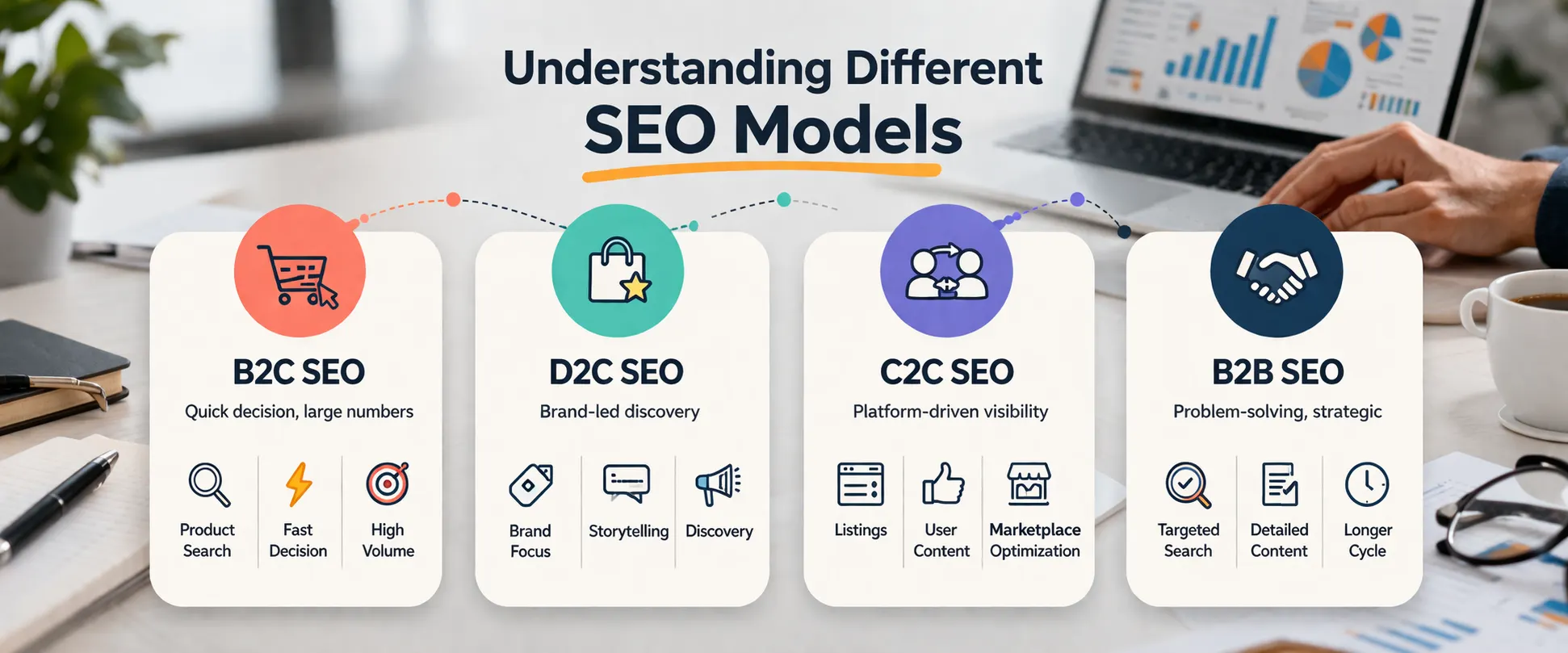
It helps to understand all industry-specific SEO strategies. This is because the most common mistake made by businesses is implementing the same SEO strategy in every market without fully comprehending the purpose of the search.
In B2C or Business-to-Consumer,
Example: A consumer who searches for “running shoes” is more likely to buy them.
The brand has a bigger role in D2C (direct-to-consumer). Storytelling is important, and SEO helps people find your brand and remember it.
When it comes to Consumer-to-Consumer SEO, the focus is on listings, user-generated content, and optimising the marketplace.
When a business searches for something, it does not simply browse; rather, it looks to solve a problem, one that may affect its functioning or earnings.
It’s a more lengthy process. This is why business-to-business SEO cannot rely on shortcuts. It requires a deeper understanding of the audience.
Let’s discuss this further.
It helps to understand all industry-specific SEO strategies. This is because the most common mistake made by businesses is implementing the same SEO strategy in every market without fully comprehending the purpose of the search.
A successful B2B SEO strategy needs to reflect how business buyers search, evaluate solutions, and make purchasing decisions. Unlike strategies focused mainly on generating large volumes of traffic, B2B SEO should prioritize relevance, search intent, credibility, and qualified leads.
| Factor | Why It Matters for B2B SEO |
|---|---|
| Goal-oriented searches | B2B buyers usually search with a specific business problem or requirement in mind. Content should target keywords that reflect those needs rather than relying only on broad, high-volume terms. |
| Content that reduces uncertainty | Potential buyers need answers before they commit to a solution. Detailed guides, comparisons, case studies, and service content can address questions around features, pricing, reliability, and suitability. |
| Multiple stages of the buying journey | B2B buyers may discover your brand through an informational search and return later when they are ready to compare providers. Your SEO strategy should therefore support awareness, consideration, and decision-stage searches. |
| Credibility and expertise | Search visibility alone does not guarantee conversions. Accurate, useful content and clear evidence of expertise can help businesses build trust with potential customers before the sales conversation. |
| Multiple decision-makers | B2B purchases often involve different stakeholders. Content should address the concerns of managers, decision-makers, technical teams, and end users where relevant. |
| Longer sales cycles | B2B decisions can take weeks or months. Maintaining consistent organic visibility through useful content helps keep your business discoverable throughout the research and evaluation process. |
The most effective B2B SEO strategy therefore focuses on getting the right content in front of the right decision-makers at the right stage of their search journey. Instead of measuring success only by traffic or rankings, businesses should also consider whether their organic visibility is attracting relevant prospects and contributing to qualified enquiries.
Now that we understand the difference, let’s talk about what actually makes a strategy work.
Most digital marketing solutions give you these points on checklists. But what really matters is how they are put into action.

Measuring B2B SEO success requires looking beyond rankings and overall website traffic. The real objective is to determine whether your SEO efforts are attracting the right audience, generating meaningful engagement, and contributing to qualified business opportunities.

We do not treat SEO as a checklist. We see it as a system. We begin by first understanding the company before anything else, including its keywords. What problem are we trying to solve? Who are we trying to solve this problem for? How will this audience find it?
Based on this understanding, our B2B digital marketing SEO system incorporates four key elements of the strategy, those which follow from actual human behaviour:
Our goal is not to create brand awareness anywhere and everywhere. Our goal is to create brand awareness in the right places.
Most digital marketing services aim to increase traffic.Unlike many digital marketing services, our focus is not to drive traffic. Rather, our goal is to increase the relevance, since relevance breeds visibility.
B2B SEO helps businesses improve search visibility, reach decision-makers, build credibility, and generate qualified leads through organic search. Unlike a strategy focused only on rankings or traffic, effective B2B SEO connects search intent, valuable content, technical optimization, and the longer B2B buying journey.
As search continues to evolve with AI-powered search experiences, businesses need content that is clear, relevant, authoritative, and genuinely useful. Measuring success through qualified organic traffic, engagement, enquiries, and conversions also provides a more accurate view of SEO performance than rankings alone.
At Blacklisted, we approach B2B SEO as a long-term growth strategy rather than a checklist of SEO tasks. By understanding your audience, creating content around real search intent, and building sustainable search visibility, we help businesses attract the right prospects at the right stage of their buying journey.

We are your go-to source for everything digital. We cover marketing tips, design trends, new tech, and how to build your brand. Every post has useful information to keep you updated and ready to tackle the digital world. It’s not just articles; it’s a way to learn, grow, and connect with others navigating the same digital journey.